
Live online cohort
ESG Reporting for Business Functions
Own your part of CSRD and ESRS reporting
The post-Omnibus environment may be more selective, but producing credible sustainability information still requires clear ownership across the business.
This live 8-session programme helps professionals understand exactly what they are responsible for, whether contributing to CSRD reporting or responding to requests from customers, lenders, investors and value-chain partners.
Across eight sessions, participants build a practical workstream blueprint for their own role, covering materiality and IRO inputs, policies, targets, metrics, data, controls, review and assurance.
They leave with five core deliverables and a focused 90-day action plan they can apply directly in their organisation.
- Dates
- 20 Oct – 8 Dec 2026
- Day
- Tuesdays
- Time
- 15:00 – 16:30 Amsterdam time
- Format
- Live online, 8 sessions
- Language
- English
Regular price €995 excl. VAT
Early Bird valid through 2 October 2026.
Register now- 20 October to 8 December 2026
- Tuesdays, 15:00 to 16:30 Amsterdam time
- 8 live online sessions of 90 minutes
- All prices excl. VAT
Have questions before registering?
Join the free webinar on Sustainability Reporting after the EU Omnibus.
Register for the webinarCannot join this cohort? Register interest for a future cohort.
Who it's for
This programme is for you if...
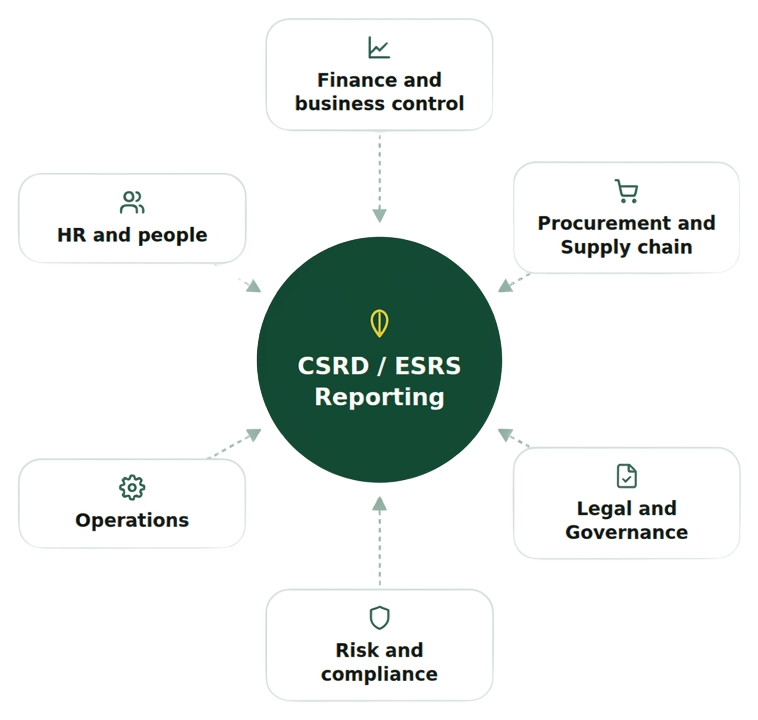
You are a mid-career or senior professional who contributes to sustainability reporting, data, controls or decision-making in functions such as:
- Finance & Controlling
- HR & People
- Procurement & Supply Chain
- Operations
- Legal & Governance
- Risk & Compliance
- Internal Audit
- Data & IT
- Corporate Communications
- Sustainability & ESG Coordination
You do not need to be a CSRD or ESRS specialist. The programme is designed for professionals who need to provide credible information, evidence, data or decisions into the reporting process.
What you'll leave with
Practical outcomes
Know your role
Understand where your function enters the reporting lifecycle.
Build clear workstreams
Turn reporting requests into scoped, owned plans.
Contribute defensible evidence
Support materiality and IRO assessments with confidence.
Spot reporting gaps
Connect policies, actions, targets, metrics and disclosures.
Prepare assurance-ready information
Build clear data definitions, controls and audit trails.
Leave with a plan
Create your reporting blueprint and 90-day action plan.

Your trainer
José Yakoubian
Independent ESG, sustainable finance and climate advisor · Founder of GreenLine Studio
José is an Amsterdam-based independent ESG, sustainable finance and climate advisor, and the founder of GreenLine Studio, with 20 years of experience across engineering, ESG risk assessment and corporate reporting.
Before founding the firm, he advised companies at Grant Thornton Netherlands on CSRD readiness, double materiality and ESRS gap assessments. He also spent nearly six years at Morningstar Sustainalytics assessing ESG risks and sustainable finance frameworks.
José began his career as a field engineer in the energy industry, which shaped how he approaches sustainability data: from the asset level upward, not only from the reporting level downward. Today he supports companies and financial institutions on EU Taxonomy, climate transition planning, ESG governance and assurance readiness, and trains corporate teams on ESG reporting and business risk, helping them turn sustainability requirements into decisions that can survive external scrutiny.
Curriculum
What you'll learn
Eight live modules. One integrated case. One blueprint built step by step.
ONE CASE. EIGHT SESSIONS.
Learn through a realistic reporting cycle
Throughout the programme, you work with NordCore Group, a simulated European company preparing for its next sustainability reporting cycle.
You take a functional perspective and face realistic reporting requests, evidence gaps, data-quality issues, deadlines and review challenges. As the case develops, you see how decisions and information move between functions.
One integrated case
The same company and reporting cycle across all eight sessions.
Function-specific challenges
Different roles face different requests, gaps, deadlines and decisions.
A practical final output
Build and defend your reporting blueprint and 90-day action plan.
By Session 8, the pieces come together into your Reporting Workstream Blueprint and 90-day action plan.
Meet NordCore Group
NordCore is a simulated European industrial and services group with €520m consolidated turnover, 1,350 employees, operations across five EU countries, significant energy use and a complex supplier base.
01Why your function is still involved, and what you own
Purpose
Give the minimum regulatory and market context so participants understand why requests continue and where their role enters the process.
Key concepts
What changed under the Omnibus and what did not; the three reporting lanes (directly in scope, affected through the value chain, voluntary); how CSRD, ESRS and the Voluntary Standard fit together at a high level; the end-to-end reporting lifecycle and where functions plug in; the boundary between what the course covers and what stays with the reporting lead, legal counsel and assurance provider; the blueprint readiness rubric is introduced here as the target.
Activity
Classify three short company scenarios into lanes and mark where your function enters.
Case link
Determine NordCore's reporting lane and each role pack's responsibilities.
Output
A personal function-impact map (why I am involved, what I may own, who depends on my input), which becomes the cover of the blueprint.
Core deliverable
1, the workstream charter.
02From reporting request to a scoped workstream
Purpose
Turn a technical disclosure request into a bounded assignment inside the participant's function.
Key concepts
Navigating an ESRS request without reading the standards line by line; breaking a request into narrative, policy, action, target, metric and evidence; the four ownership roles (data production, review, approval, disclosure); workstream boundaries, dependencies, decision rights and the participant's own place in the RACI; milestones, review points and a defined escalation route.
Activity
Decode a deliberately ambiguous request and list what must be clarified before work begins.
Case link
Each NordCore role converts a different request into a scoped assignment.
Output
A one-page workstream charter (scope, owner, inputs, outputs, timeline, dependencies, escalation).
Core deliverable
1, the workstream charter.
03Contributing evidence to materiality and IROs
Purpose
Enable contributors to add useful evidence to double materiality and the impact, risk and opportunity assessment without leading the methodology.
Key concepts
Impact and financial materiality in plain language, and why the two blur in practice, so prioritisation must reflect both impact severity and financial exposure; what functions know that the reporting team does not; evidence versus opinion versus stakeholder input; how a functional input actually changes a materiality decision; documenting assumptions, uncertainty and disagreement; avoiding broad data collection disconnected from material topics.
Activity
Assess a small set of candidate topics from your function's angle and justify what evidence is relevant.
Case link
NordCore teams weigh climate, workforce, supplier labour, operational safety and business-conduct issues.
Output
A functional IRO and evidence map (issue, relevance, source, owner, unresolved question).
Core deliverable
2, the evidence map.
04The story behind the data: policies, actions, targets and metrics
Purpose
Show that credible reporting is a coherent chain from intent to proof, not a set of isolated KPIs.
Key concepts
How policies, actions, targets and metrics connect, and who owns each link; distinguishing a commitment, an implemented action and a measured result; baselines, target periods, methodologies and ownership; finding gaps between policy language and operational reality; recognising unsupported or overstated claims (introduced here, exercised in full in Module 7).
Activity
A claim-and-evidence autopsy on a weak disclosure, rebuilt using only the evidence available.
Case link
Each NordCore role tests whether its policy-to-action-to-target-to-metric chain is internally consistent.
Output
A policy, action, target and metric evidence map plus a list of disclosure gaps to correct or escalate.
Core deliverable
2, the evidence map.
05Data quality in practice: definitions, boundaries, estimates and the value-chain cap
Purpose
Prepare data that is consistent, explainable and usable for reporting and review.
Key concepts
Clear metric definitions, reporting boundaries and source systems; data lineage at contributor level (where the number came from, who changed it); methodologies, estimates, proxies and limitations; period and boundary consistency; value-chain and Scope 3 inputs, including the value-chain cap (partners with 1,000 or fewer employees may decline anything beyond the Voluntary Standard, and the requester must indicate which items exceed the cap and state that right; it applies only to CSRD reporting) and how to request supplier information proportionately; coverage percentages, and separating a refusal from a non-response; issue logs and version control. Deep lineage and consolidation are routed to the finance and data role packs rather than the whole cohort.
Activity
Review a flawed submission (inconsistent boundaries, unsupported estimates, duplicate figures, missing evidence) and write the specification and issue log that would have prevented the defects.
Case link
NordCore's finance, HR, procurement and operations packs each contain a different data-quality failure.
Output
A data-specification sheet, quality checklist and issue log for one functional metric.
Core deliverable
3, the data-specification sheet.
06Controls, documentation and assurance readiness
Purpose
Move participants from sending the number to producing information that survives management challenge and limited assurance.
Key concepts
What limited assurance means for a contributor; preventive and detective controls; evidence standards, retention and traceability; review, approval and sign-off; managing corrections, late changes and exceptions; the one-line test that separates reliable evidence from unsupported narrative; the few assurance findings contributors cause. Held at contributor level: participants learn what a reviewer will ask and what evidence answers it, not audit methodology.
Activity
Design proportionate controls for one metric and stress-test whether the retained evidence would support a reviewer's challenge.
Case link
NordCore receives assurance questions on workforce, emissions and supplier information.
Output
A control-and-evidence matrix (risk, control, owner, reviewer, frequency, retained evidence).
Core deliverable
4, the control-and-evidence matrix.
07Running the workstream: collaboration, escalation and credible claims (live simulation)
Purpose
Build the coordination and judgement needed when reporting crosses functions, systems and deadlines.
Key concepts
Running effective data-owner and issue-resolution conversations; escalating missing data, changed methodologies and disputed ownership; working with sustainability, finance, legal, communications, internal audit and assurance; challenging public claims not supported by the reporting record; documenting decisions so the rationale is visible later. All claim-and-escalation work is consolidated in this module.
Activity
A live simulation with late data, a methodology change, conflicting owners and an unsupported external claim; participants decide what can be reported, what must be qualified and what must be escalated, then justify each decision.
Case link
NordCore must resolve the same conflicts across roles.
Output
An escalation map and a claim-challenge checklist.
Core deliverable
5, the operating plan with 90-day actions.
08Capstone: build, operate and defend your workstream
Purpose
Integrate the course into a practical operating model participants can take back to work.
Key concepts
Workstream readiness and maturity against the shared rubric; prioritising gaps by reporting risk and business impact; the minimum viable process for the next cycle, including the reporting calendar and governance rhythm; resource, system and capability needs; peer challenge focused on your contribution and its defensibility; continuous improvement after the cycle.
Activity
A five-minute defence of your blueprint against structured peer challenge, where peers probe evidence and defensibility rather than enterprise-level decisions.
Case link
Each NordCore role completes its workstream and the class tests whether the combined process is coherent.
Output
A role-specific reporting workstream blueprint and a 90-day action plan.
Core deliverable
Assembles all five into the blueprint, and completes 5, the operating plan and 90-day plan.
Schedule
8 live sessions
Weekly live online sessions on Tuesdays, 15:00–16:30 The Netherlands local time (Europe/Amsterdam), from 20 October to 8 December 2026. There is one break week on 24 November 2026.
- 01Tuesday, 20 October 2026
15:00–16:30 Amsterdam time · 90 minutes - 02Tuesday, 27 October 2026
15:00–16:30 Amsterdam time · 90 minutes - 03Tuesday, 3 November 2026
15:00–16:30 Amsterdam time · 90 minutes - 04Tuesday, 10 November 2026
15:00–16:30 Amsterdam time · 90 minutes - 05Tuesday, 17 November 2026
15:00–16:30 Amsterdam time · 90 minutes - 06Tuesday, 1 December 2026
15:00–16:30 Amsterdam time · 90 minutes - 07Tuesday, 8 December 2026
15:00–16:30 Amsterdam time · 90 minutes - 08Tuesday, 8 December 2026
15:00–16:30 Amsterdam time · 90 minutes
FAQ
FAQ
Is this programme right for my role?
The programme is designed for mid-career and senior professionals across finance, HR, procurement, operations, risk, legal, data, internal audit, communications, sustainability and other functions that contribute to sustainability reporting.
Do I need prior CSRD or ESRS knowledge?
No. The programme provides the regulatory context you need, then focuses on practical ownership, collaboration and implementation.
What if my company is no longer in CSRD scope?
The programme is still relevant. Companies outside mandatory CSRD scope may still receive sustainability-information requests from customers, lenders, investors and larger value-chain partners.
What will I finish the programme with?
A completed Reporting Workstream Blueprint and a practical 90-day action plan for your role.
How practical is the programme?
Very practical. The programme runs through one continuous simulated reporting cycle using NordCore Group, a realistic fictional company. Across eight sessions, you work through reporting requests, evidence gaps, data-quality issues, cross-functional dependencies, review challenges and escalation decisions, building your workstream blueprint step by step.
How much work is required between sessions?
There are eight 90-minute live sessions, plus approximately 1 to 2 hours of applied work between sessions.
Will I receive a certificate?
Participants who meet the completion requirements receive a tmrw.earth Certificate of Completion.
What does the programme cost?
Early Bird registration is €795 excl. VAT through 2 October 2026. The regular price is €995 excl. VAT.
Can my employer pay by invoice?
Yes. We can provide an invoice for employer-sponsored participation.
Have another question that is not answered here? Please email us and we will be happy to help.
Join the October cohort
Own your part of CSRD and ESRS reporting, and leave with a Reporting Workstream Blueprint you can put to work immediately.
- 20 October to 8 December 2026
- Tuesdays
- 15:00 to 16:30 Amsterdam time
- Live online
- 8 × 90-minute sessions
- Delivered in English
Save €200 with Early Bird registration.
Early Bird
€795
Excl. VAT · Valid through 2 October 2026
Regular
€995
Excl. VAT · After the Early Bird deadline
All prices are excl. VAT. Participants who meet the completion requirements receive a tmrw.earth certificate of completion.